---
title: "E1M-X V2N-M1"
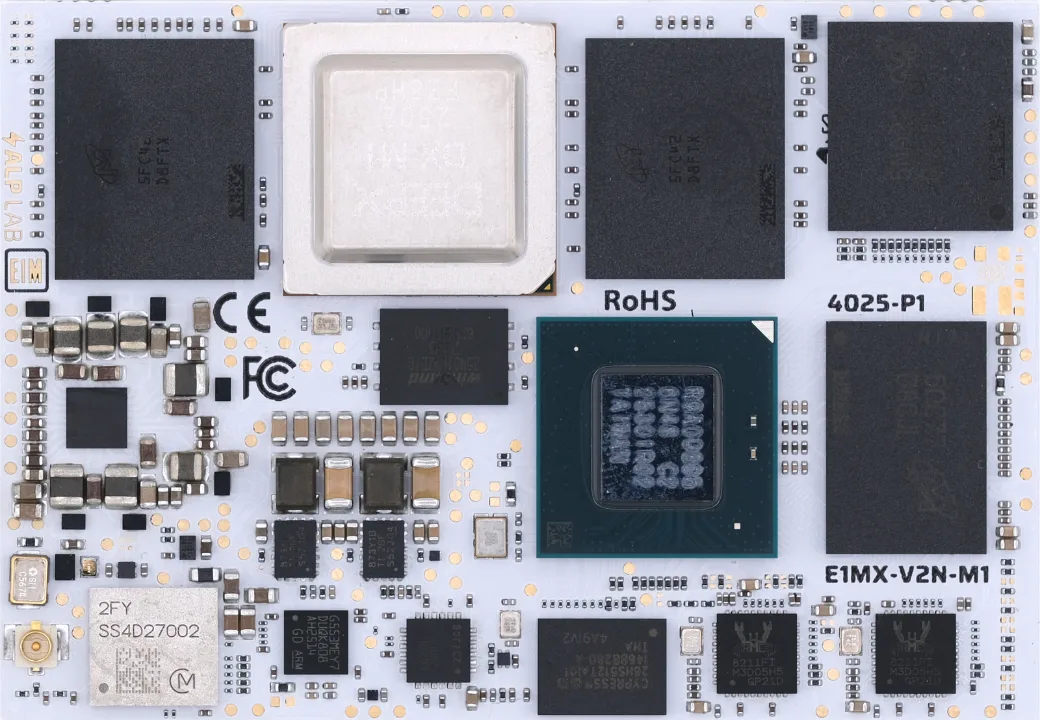
description: "The E1M-X V2N-M1 combines the Renesas RZ/V2N processor (with its 4 TOPS DRP-AI3) with the on-module DEEPX DX-M1 NPU (25 TOPS dense), in the same 45 × 65 mm E1M-X form factor as the base V2N."
source: https://docs.alplab.ai/e1m/e1m-x-v2n-m1
---
# E1M-X V2N-M1
The E1M-X V2N-M1 combines the **Renesas RZ/V2N** processor (with its 4 TOPS DRP-AI3) with the on-module **DEEPX DX-M1** NPU (25 TOPS dense), in the same 45 × 65 mm E1M-X form factor as the base V2N.
 ## Module variants
| SKU | Memory | Status |
|----------------|------------------------------------|-------------|
| `E1M-V2M101` | 4 GB LPDDR4X + 4 GB eMMC + DX-M1 | shipping |
| `E1M-V2M102` | 8 GB LPDDR4X + 16 GB eMMC + DX-M1 | shipping |
| `E1M-V2M103` | 4 GB LPDDR4X + 16 GB eMMC + DX-M1 | shipping |
The E1M-X V2N-M1 datasheet (DS-V2N-M1-001) has the status *Preliminary*.
`E1M-V2M103` (4 GB RAM / 16 GB eMMC) gained an SDK preset in alp-sdk v0.17.0 and is the SKU the SDK's V2M bench runs; the same release corrected `E1M-V2M102`'s eMMC from 8 GB to **16 GB**. The eMMC is 4 GB on `E1M-V2M101` and 16 GB on `E1M-V2M102` / `E1M-V2M103` (DS-V2N-M1-001 0.16). The Cortex-M33 Zephyr board tree is generated for `E1M-V2M101` (`alp_e1m_v2m101_m33_sm`).
## At a glance
| Parameter | Value |
|---------------------|---------------------------------------------|
| Application core | Quad Arm Cortex-A55 @ 1.8 GHz (RZ/V2N) |
| Real-time core | Arm Cortex-M33 @ 200 MHz (RZ/V2N) |
| AI accelerator 1 | Renesas DRP-AI3 (4 TOPS dense) |
| AI accelerator 2 | DEEPX DX-M1 (25 TOPS) |
| Total AI throughput | 4 + 25 TOPS (dense) |
| Module outline | 45 × 65 mm; module height TBD (DS-V2N-M1-001) |
| Form factor | E1M-X (45 × 65 mm), LGA, 1.0 mm pitch |
| Operating temperature | −40 to +85 °C |
| OS targets | Yocto Linux (A55) · Zephyr (M33; board target for `E1M-V2M101`) |
## What's added vs the V2N base
V2N-M1 inherits the full V2N base module ([see V2N](https://docs.alplab.ai/e1m/e1m-x-v2n)) and adds:
| Component | Where + how |
|--------------------------|------------------------------------------------------------|
| **DEEPX DX-M1 NPU** | On-module, PCIe |
| `M1_RESET` | Renesas-side GPIO controlling DX-M1 reset (active-low) |
| 2 × PI3DBS12212A muxes | Switch PCIe routing between DEEPX and the E1M edge |
| 0.75 V DEEPX rail | DA9292 CH2 (disabled on V2N base; brought up by **U-Boot** on M1) |
| 3 × TPS628640 bucks | DDR5/LPDDR rails for DEEPX (`0x44 / 0x48 / 0x4F`, all bench-confirmed) |
## Dual-accelerator architecture

*Figure: E1M-X V2N-M1 block diagram. The PCIe mux links the RZ/V2N PCIe Gen3 x2 to the DX-M1 (SEL 0) or to the `PCIE0` pads (SEL 1). Dashed blocks are assembly options.*
The full pin list is in the [E1M-X V2N-M1 datasheet](https://docs.alplab.ai/e1m/e1m-x-v2n-m1/documents/datasheet).
| Accelerator | Performance | Strengths |
|--------------|---------------|------------------------------------------|
| DRP-AI3 | 4 TOPS dense | Low-latency, tightly coupled to the ISP |
| DEEPX DX-M1 | 25 TOPS dense | High-throughput, large-model support |
Workloads can be partitioned across both accelerators. A vision pipeline might run a lightweight detection model on the DRP-AI3 while a heavier classification or segmentation model runs on the DEEPX side.
## DEEPX bring-up
As of alp-sdk v0.17.0 the whole DEEPX power and reset sequence is owned by **U-Boot**, in `board_late_init()` on the A55, before Linux or the Cortex-M33 image starts. No application firmware — CM33 or Linux — writes or re-runs it:
1. **Bring up the 0.75 V DEEPX rail** via the secondary PMIC's CH2, over `BRD_I2C`, and poll it to power-good. `BRD_I2C` is A55/Linux-exclusive, so U-Boot — not the CM33 — is the sole writer.
2. **Route the PCIe muxes** to the DEEPX path (PI3DBS12212A).
3. **Release `M1_RESET`** (active-low) — only once step 1 confirms the rail is power-good. U-Boot holds `M1_RESET` asserted through the whole rail ramp and releases it no sooner than 16 ms after the DEEPX core enable goes high (a 15 ms hold plus a 1 ms mux settle).
4. **Hand off to Linux**, which loads the DX-M1 kernel driver and the DEEPX runtime.
The three DEEPX TPS628640 bucks at `0x44` (DDR5_VDD), `0x48` (VDD0V85_LPDDR) and `0x4F` (DDR5_VDDQ_0V5) self-regulate to their factory OTP voltages with no host writes. They ACK on `BRD_I2C` only **after** step 1 has enabled the DEEPX rail, so a probe before that is not a fault; [`v2n-pmic-inspect`](https://docs.alplab.ai/sdk/examples/v2n/v2n-pmic-inspect) skips them when absent for exactly that reason. `0x48` was bench-confirmed on E1M-V2M103.
:::warning[Do not drive the DEEPX sequence from your own firmware]
`deepx_dxm1_bring_up()` in `chips/deepx_dxm1/` wraps the mux routing plus the `M1_RESET` release, for platforms where a portable caller owns those signals. **On V2N-M1 it does not apply** — U-Boot is the sole driver of `M1_RESET` — and no CM33 image may run the rail sequence. Earlier releases described a CM33-side supervisor hook doing this; that module never shipped and was removed. Walk-through: [`docs/bring-up-v2n-m1.md`](https://github.com/alplabai/alp-sdk/blob/main/docs/bring-up-v2n-m1.md).
:::
:::note[Optional-rail caveat]
There is a **fourth** TPS628640 at `0x4D` (a Renesas LPDDR4X rail) that is an assembly option on the V2N family. That one is genuinely optional — a NAK is a **skip, not a failure**.
:::
### DX-M1 on silicon
Bench-verified on **E1M-V2M103** with the image's `dx-driver` 1.8.0 + `dx-rt` 3.2.0 (from `meta-deepx-m1`) and DX-M1 firmware 2.4.0: the DX-M1 enumerates as PCIe `1ff4:0000` Gen3 x2, `dxrt-cli -s` returns rc `0`, and DEEPX's public `.dxnn` models run with `run_model`. The DX-M1 host-side C sequencer in `chips/deepx_dxm1/` itself remains `hil_silicon: untested` in the chip registry — it is not what brings the part up on V2N-M1.
Two runtime facts worth knowing before you ship:
- **`dxrtd` service mode is enabled** in the image, so more than one process can share the DX-M1 — but at most **3 distinct NPU core sets** can be live on one DX-M1 at a time. Inside one process the SDK refuses a fourth with `ALP_ERR_BUSY`; across processes nothing guards it. To run two models on the DX-M1 side by side, open them with disjoint `alp_inference_config_t::accel_unit_mask` values (bit `n` = NPU core `n`).
- **`libdxrt` installs crash handlers at load.** Because `libalp_sdk` links `libdxrt` on V2M, every SDK application there has its `SIGSEGV` / `SIGBUS` / `SIGABRT` turned into a silent `exit(1)`. An app that needs core dumps reinstalls `SIG_DFL` at start-up.
## DEEPX userland
The DEEPX silicon's userland API (`libdxrt.so`) is upstream at [`github.com/DEEPX-AI/dx_rt`](https://github.com/DEEPX-AI/dx_rt). The Yocto layer that brings it into your image is wired in `meta-alp-sdk/conf/machine/e1m-v2m101-a55.conf` and references [`github.com/DEEPX-AI/meta-deepx-m1`](https://github.com/DEEPX-AI/meta-deepx-m1).
ONNX models are converted to the `.dxnn` format using the DEEPX compiler; the workflow is model-family agnostic.
## GD32 supervisor bridge firmware
V2N-M1 inherits the V2N base module's GD32G553 supervisor MCU and its [bridge peripheral surface](https://docs.alplab.ai/e1m/e1m-x-v2n#gd32-supervisor-mcu) unchanged — including how the bridge firmware gets programmed.
:::caution[`tan flash` does not program the GD32 on V2M SKUs either]
`E1M-V2M101`, `E1M-V2M102` and `E1M-V2M103` all carry the same `gd32_bridge` helper entry as the V2N base: **`flash_policy: recovery_only`**, and **no local flash path** — `flash_method: swd_probe` and its `flash_args` were removed outright, putting GD32 programming **out of `tan`'s scope**. Alp Lab programs the part in production; a customer flash is only ever bricked-device recovery with Alp Lab-supplied binaries.
`tan flash` declines the entry with status **`skipped`** and rc **`-1`**:
```text
flash: helper 'gd32_bridge' is programmed by Alp Lab in production and is customer-flashable only to recover a bricked device...; skipping. Field updates arrive over update_channel: alp_ota_spi_bridge. To recover a bricked device deliberately, re-run with --helper gd32_bridge --recover.
```
Field updates go over **`update_channel: alp_ota_spi_bridge`**. To take the recovery path deliberately, pass **`--helper gd32_bridge --recover`**. The physical SWD routes are unchanged — see [GD32 SWD Flash](https://docs.alplab.ai/sdk/examples/v2n/v2n-gd32-swd-flash).
:::
:::warning[Neither candidate GD32 IDCODE has been measured]
``'s `GD32_SWD_GENERIC_CM33_R0P1_IDCODE 0x6BA02477u` (named `GD32_SWD_EXPECTED_IDCODE` before alp-sdk v0.17.0) is the **generic ADIv5 SW-DP IDCODE for a Cortex-M33 r0p1 SW-DPv2** and is **UNVERIFIED on a GD32G553**. `0x6BA02477` is also what the **V2N CM33 DAP** reports (`Found Cortex-M33 r0p4`) — a different target on the same board. The other GD32 candidate on record, `0x0BE12477`, has no bench transcript or datasheet behind it; an earlier version of this page wrongly presented it as the measured GD32 value.
`gd32_swd_connect()` deliberately does not treat a mismatch as fatal, and neither should your code. A production test that wants to refuse on a mismatch must match against a value **measured on its own board**.
:::
## Changing from V2N to V2N-M1
V2N-M1 has the same E1M-X footprint and outline as the V2N base, but it is **not** a drop-in replacement on every V2N carrier. Check the carrier against these differences (DS-V2N-M1-001):
- **IO pads routed to the DX-M1.** `IO0`–`IO6` (`L2`, `M2`, `N2`, `O2`, `AF2`, `AG2`, `AL2`), `IO17`–`IO22` (`AQ26`, `AR26`, `AQ27`, `AR27`, `AQ28`, `AR28`) and `IO24` (`AR29`) are routed to the on-module DX-M1. They are available as carrier GPIO only after a DeepX software patch. A carrier that drives or reads these pads on a V2N needs a design review.
- **`PCIE0` is multiplexed** between the on-module DX-M1 and the E1M-X edge. A carrier that uses the edge `PCIE0` port shares it with the DX-M1.
- **5 V supply.** Size the 5 V source for the higher peak current of DRP-AI3 + DX-M1 + dual Ethernet (≥ 5 A peak to `VDD_5V_IN`), compared to a V2N-only carrier.
The software changes:
- Switch `som.sku` to `E1M-V2M101` (or `E1M-V2M102` / `E1M-V2M103`) in your `board.yaml`. The SoM preset's `capabilities:` block declares both `drp_ai` and `deepx_dx`, so the loader compiles in **both** dispatchers; no `inference.backend:` knob to set (that field was removed in v0.6 follow-up cleanup — it's silicon-determined).
- Open an inference handle per accelerator at runtime via `alp_inference_open(.backend = ALP_INFERENCE_BACKEND_DEEPX_DXM1)` (or `_DRPAI` for the on-die NPU). With `.backend = ALP_INFERENCE_BACKEND_AUTO` the model format decides: a DXNN model goes to the DX-M1, a DRP-AI model to DRP-AI3. One model on each NPU at the same time is what [`v2n-two-models`](https://docs.alplab.ai/sdk/examples/v2n/v2n-two-models) does — `[UNTESTED on silicon]`, and its DRP-AI half needs a RUHMI-enabled `libalp_sdk`.
- Ship a Yocto image built against `e1m-v2m101-a55.conf` (includes the DEEPX kernel driver and userland).
## Getting started
1. Mount the E1M-X V2N-M1 on a compatible board.
2. Flash the V2N-M1 Yocto image (DEEPX driver + `libdxrt.so` included).
3. For M33 development, drop a `board.yaml` with `som.sku: E1M-V2M101` and follow the [Quick Start](https://docs.alplab.ai/sdk/quick-start).
## Resources
- [Firmware quickstart](https://docs.alplab.ai/sdk/firmware-quickstart) — V2N-M1 bring-up
- [``](https://docs.alplab.ai/sdk/api/inference) — DEEPX dispatcher
- [Chip catalogue](https://docs.alplab.ai/sdk/chips)
- [Industrial inquiries](https://alplab.ai/contact-us/)