---
title: "E1M-X V2N"
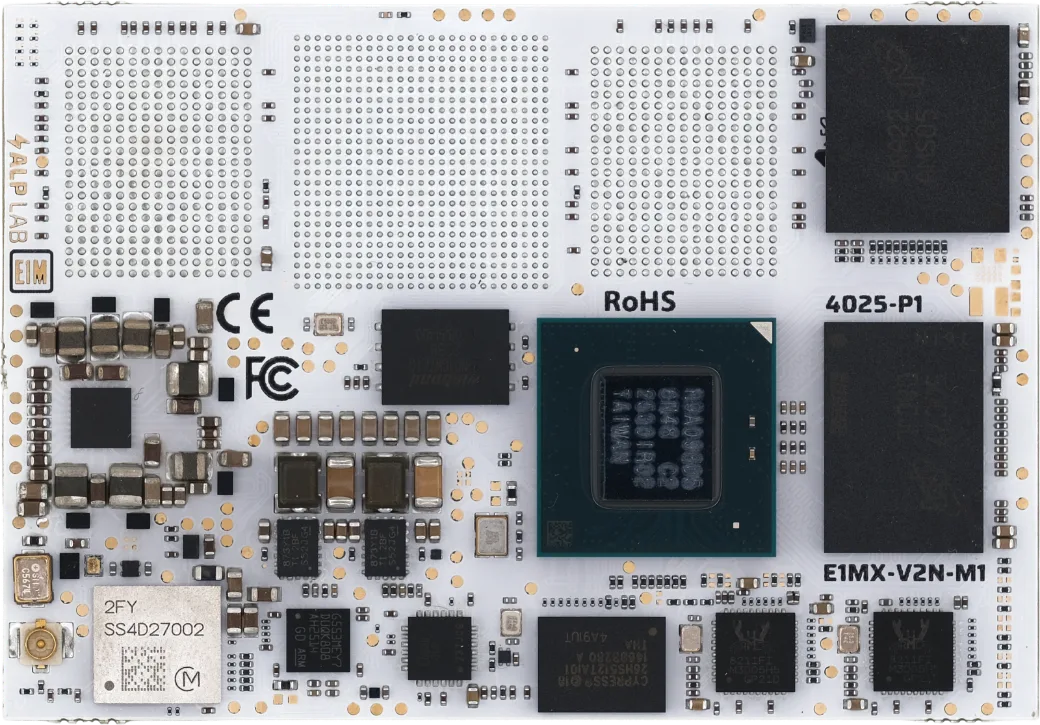
description: "The E1M-X V2N is a high-performance edge AI System-on-Module powered by Renesas RZ/V2N, combining quad Cortex-A55 application cores with a dedicated DRP-AI3 accelerator for real-time vision and inference workloads. It ships in the 45 × 65 mm E1M-X form factor."
source: https://docs.alplab.ai/e1m/e1m-x-v2n
---
# E1M-X V2N
The E1M-X V2N is a high-performance edge AI System-on-Module powered by **Renesas RZ/V2N**, combining quad Cortex-A55 application cores with a dedicated DRP-AI3 accelerator for real-time vision and inference workloads. It ships in the 45 × 65 mm **E1M-X** form factor.
 ## Module variants
All three SKUs share the same silicon + PCB. Pick by memory budget.
| SKU | Memory | Status |
|----------------|----------------------------|-------------|
| `E1M-V2N101` | 4 GB LPDDR4X + 4 GB eMMC | shipping |
| `E1M-V2N102` | 8 GB LPDDR4X + 16 GB eMMC | shipping |
| `E1M-V2N103` | 4 GB LPDDR4X + 16 GB eMMC | shipping |
The E1M-X V2N datasheet (DS-V2N-001) has the status *Preliminary*.
`E1M-V2N103` (4 GB RAM / 16 GB eMMC) gained an SDK preset in alp-sdk v0.17.0, and the same release corrected `E1M-V2N102`'s eMMC from 8 GB to **16 GB**. In alp-sdk v0.17.0 only `E1M-V2N101` has a generated Cortex-M33 Zephyr board tree; `E1M-V2N102` / `E1M-V2N103` are memory-tier variants of the same PCB.
## At a glance
| Parameter | Value |
|---------------------|---------------------------------------------|
| Application core | Quad Arm Cortex-A55 @ 1.8 GHz |
| Real-time core | Arm Cortex-M33 @ 200 MHz |
| AI accelerator | Renesas DRP-AI3 |
| AI performance | 4 TOPS (dense) |
| Module outline | 45 × 65 mm; module height TBD (DS-V2N-001) |
| Form factor | E1M-X (45 × 65 mm), LGA, 1.0 mm pitch |
| Operating temperature | −40 to +85 °C |
| OS targets | Yocto Linux (A55) · Zephyr (M33; board target for `E1M-V2N101`) |
## What's on the module
| Role | Part | Bus / signal | Driver |
|-------------------------|----------------------------|------------------|-------------------------------------|
| Application SoC | Renesas RZ/V2N (R9A09G056N44) | -- | (vendor HAL) |
| Companion supervisor MCU| GigaDevice GD32G553MEY7TR | SPI + I2C bridge | `` |
| Primary PMIC | Qorvo ACT88760-120.E1 | I2C `0x25/0x26` | `` |
| Secondary PMIC | Renesas DA9292 | I2C `0x1E` | `` |
| Clock generator | Renesas / IDT 5L35023B | I2C `0x69` | `` |
| RTC | Micro Crystal RV-3028-C7 | I2C `0x52` | Linux `rtc-rv3028` (`/dev/rtc0`); `` |
| Temperature sensor | TI TMP112 | I2C `0x40` | `` |
| Secure element | Infineon OPTIGA Trust M | I2C `0x30` | `` (probe-only) |
| EEPROM (SoM manifest) | Onsemi N24S128 | I2C `0x50` | `` |
| Wi-Fi 6 + BLE 5.4 | Murata LBEE5HY2FY-922 | SDIO + UART + I2S| `` |
| Ethernet PHY ×2 | Realtek RTL8211FI-VD-CG | RGMII + MDIO | `` |
| eMMC | (variant per SKU) | Renesas SD0 | Linux (A55-owned); no alp-sdk driver |
| NOR flash | Macronix MX25UW51245G, 512 Mbit (same on all SKUs, boot-supported) | Renesas xSPI0 | Linux (A55-owned); no alp-sdk driver |
A fourth TPS628640 buck at `0x4D` (a Renesas LPDDR4X rail) is an **assembly option** on this SKU — firmware treats a no-ACK there as a skip, not a failure.
:::note[Two on-module I2C buses, not one]
Those addresses are spread across **two separate buses**, both mastered by the RZ/V2N:
- **`brd_i2c`** — RV-3028-C7 `0x52` · OPTIGA Trust M `0x30` · TMP112 `0x40` · 5L35023B `0x69` · GD32G553 `0x70` · ACT88760 `0x25`/`0x26` · DA9292 `0x1E` · TPS628640 `0x4D` (assembly option).
- **`e1m_i2c0`** — the 24C128 SoM-manifest EEPROM at `0x50`, plus `0x58` — the **same** EEPROM's identity page (Secure Data Page / Unique ID), not a second chip.
Anything you add at the carrier must avoid colliding with the addresses already occupied on whichever of the two you extend.
:::
:::caution[`brd_i2c` is A55/Linux-exclusive (alp-sdk v0.17.0)]
The Cortex-A55 / Linux side is the **sole master of the whole `brd_i2c` bus** — every device on it. The Cortex-M33 must not master it at all, and the M33 Zephyr board no longer claims it. Code that reads the TMP112, OPTIGA Trust M, PMICs or RTC runs on the A55 through the portable `` surface (Linux `/dev/i2c-8`); see [`v2n-temp-sensor`](https://docs.alplab.ai/sdk/examples/v2n/v2n-temp-sensor), [`v2n-secure-element-sign`](https://docs.alplab.ai/sdk/examples/v2n/v2n-secure-element-sign) and [`v2n-pmic-inspect`](https://docs.alplab.ai/sdk/examples/v2n/v2n-pmic-inspect). Two addresses already have Linux kernel drivers bound: the RV-3028-C7 (`0x52`, `/dev/rtc0`) and the GD32G553 I²C slave (`0x70`, the `alplab,gd32-bridge-gpio` expander).
:::
:::note[Two I²C addresses corrected in alp-sdk v0.17.0]
- **TMP112: `0x40`.** The fitted TMP112 package straps ADD0 to GND at `0x40`, confirmed on silicon. An earlier revision of this page argued for `0x48` (the generic datasheet strap-table reading) — that was wrong for this package.
- **5L35023B: `0x69`**, not `0x68`, confirmed on silicon.
:::
## Processor architecture

*Figure: E1M-X V2N block diagram. Dashed blocks are not fitted: the CAN PHYs (the CAN pads carry CAN FD TX / RX logic signals) and the RF feed to the MHF 4L receptacle.*
The full pin list is in the [E1M-X V2N datasheet](https://docs.alplab.ai/e1m/e1m-x-v2n/documents/datasheet).
### Application cores (Cortex-A55)
Four Cortex-A55 cores running at up to 1.8 GHz host a full Linux distribution (Yocto-built). They handle application logic, networking, display output, and pre/post-processing for AI pipelines.
### Real-time core (Cortex-M33)
The Cortex-M33 subsystem (200 MHz) operates independently and runs Zephyr firmware via the Alp SDK. It is suited to:
- Sensor data acquisition with deterministic latency
- PWM and motor control
The E1M-X V2N is not currently certified for safety-critical applications (IEC 61508, ISO 26262, IEC 62304, etc.; DS-V2N-001).
### DRP-AI3 accelerator
Renesas's DRP-AI3 provides 4 TOPS of dense inference performance. Models are deployed through the SDK's [``](https://docs.alplab.ai/sdk/api/inference) dispatcher on the A55 (Linux / Yocto). DRP-AI3 is a Linux backend with no Zephyr Kconfig symbol: the Yocto build enables it when `meta-rz-drpai` is in `bblayers.conf` and `ALP_ENABLE_DRPAI` is `"1"`, which is the default whenever that layer is present. Model conversion uses the upstream DRP-AI Translator toolchain.
## GD32 supervisor MCU
The V2N module's GD32G553 supervisor MCU owns **all eight E1M PWM channels** (PWM0..PWM7), the dual ADC/DAC bank, the Wi-Fi/BT REG_ON pins, the OPTIGA reset, and 18 IO routes to the E1M edge.
> **2026-05 hardware decision: GD32-only PWMs.** The earlier "either GD32 or Renesas, picked SoM-wide via resistor strap" cross-source design was dropped — Renesas drives no PWMs on V2N. The resistor-strap selection is no longer applicable; there's nothing to switch between.
:::note[Design against the E1M edge, not the module internals]
The supervisor's own pin assignments are module-internal implementation detail and are deliberately not published. Your carrier design targets the E1M edge connector — that is the interface the [lifecycle statement's](https://docs.alplab.ai/resources/lifecycle-statement) form-fit-function guarantee covers across hardware revisions. Access the supervisor's peripherals through the portable `` surfaces, which stay stable even if the internal routing changes.
:::
### Bridge-only peripheral classes
On V2N (and V2N-M1), **five** portable peripheral classes are served **exclusively** by the GD32 IO-MCU bridge. There is no native RZ/V2N path for any of them, and none is planned:
| Class | Portable API | Connector-position IDs |
|---|---|---|
| `adc` | [``](https://docs.alplab.ai/sdk/api/adc) | `ALP_E1M_X_ADC0`..`ALP_E1M_X_ADC7` |
| `pwm` | [``](https://docs.alplab.ai/sdk/api/pwm) | `ALP_E1M_X_PWM0`..`ALP_E1M_X_PWM7` |
| `dac` | [``](https://docs.alplab.ai/sdk/api/dac) | `ALP_E1M_X_DAC0`..`ALP_E1M_X_DAC1` |
| `counter` | [``](https://docs.alplab.ai/sdk/api/counter) | — |
| `qenc` (quadrature encoder) | [``](https://docs.alplab.ai/sdk/api/counter) — `alp_qenc_open()` | `ALP_E1M_X_ENC0`..`ALP_E1M_X_ENC3` |
The RZ/V2N SoC metadata has **no `dac` key at all** — the portable `alp_dac` surface exists on V2N solely because of the bridge.
Those IDs are always routed through the bridge. There is **no fallback backend**, because a "native" candidate has no pad to reach. If the bridge is unreachable, the portable `alp_*_open()` call fails rather than silently degrading:
| Condition | Result |
|---|---|
| Neither supervisor bus opening | `ALP_ERR_NOT_READY` |
| Supervisor mutex timeout | `ALP_ERR_BUSY` |
| Built without supervisor support | `ALP_ERR_NOSUPPORT` |
Two current limits, stated plainly:
- The bridge ADC path exposes **no hardware oversampling or triggering**. That is an SDK gap, not a bridge limitation.
- `counter` `set_alarm` returns `ALP_ERR_NOSUPPORT` — there is no interrupt line from the GD32 back to the Renesas SoC.
### Host transports
The host driver speaks both transports:
- **SPI fast path** — Renesas SCI7 (Simple-SPI master) ↔ GD32 slave at up to **25 MHz**, silicon-validated with a full-DMA slave data path on the GD32 side and a zero-interrupt polled engine on the host. Use for high-frequency telemetry and PWM updates. (A move to RSPI is planned for the next hardware revision.)
- **I2C management path** — on `BRD_I2C`, GD32 at 7-bit `0x70`. `BRD_I2C` is A55 / Linux-exclusive, so this path is for the A55 only; the Linux kernel already binds the GD32 I²C slave as the `alplab,gd32-bridge-gpio` expander.
As of alp-sdk v0.17.0 the bridge **firmware lives in its own repository**, [`alplabai/gd32-bridge-firmware`](https://github.com/alplabai/gd32-bridge-firmware); alp-sdk keeps the host driver and the canonical wire-protocol header, which the firmware compiles against. The firmware release version and the wire-protocol version are independent axes: `GET_VERSION` returns the protocol triple, `GET_BUILD_ID` returns the firmware release plus its build SHA.
Protocol history since v0.6:
| Protocol | Adds |
|----------|------|
| **v0.7** | `LINK_FEATURES` negotiation with a `STATUS_SEQ` reply stamp that kills stale-reply hazards on the SPI link; `OTA_BEGIN` records the incoming image version into the A/B slot metadata |
| **v0.8** | `SE_RESET` — host control of the on-module secure element's reset line |
| **v0.9** | ADC oversample / resolution control, PWM center-aligned mode, and an ADC DSP chain with runtime dispatch — FAC-backed FIR/IIR filtering plus a hardware FFT spectrum path read back over `ADC_SPECTRUM_READ` |
Each of these is additive and backward-compatible by construction — an older host simply never sends the new opcodes, and v0.7's negotiated framing is byte-identical to v0.6 until `LINK_FEATURES` is agreed. The alp-sdk v0.17.0 host driver refuses a bridge whose protocol **major** differs from its own (`GD32G553_HOST_PROTOCOL_MAJOR`, `0`), and **gates each newer feature on the minor the bridge advertises** — below a feature's minimum minor the call returns `ALP_ERR_NOSUPPORT` rather than sending a request the firmware would misread:
| Minimum minor | Feature (host macro) |
|---|---|
| 11 | Wi-Fi / BT `REG_ON` enables as bridge GPIO lines (`GD32G553_REG_ON_MIN_PROTOCOL_MINOR`) |
| 13 | CAN transceiver standby as a bridge GPIO line (`GD32G553_CAN_STBY_MIN_PROTOCOL_MINOR`) |
| 14 | The OTA error cause in `gd32g553_ota_get_state()` (`GD32G553_OTA_ERR_MIN_PROTOCOL_MINOR`) |
| 15 | v0.15 link features — `STATUS_SEQ`, 256-byte `BIG_FRAME`s, `ADC_STREAM2`, `BATCH` (`GD32G553_V015_MIN_PROTOCOL_MINOR`) |
| 16 | E1M `IO15` / `IO26` as bridge GPIO (`GD32G553_IO15_IO26_MIN_PROTOCOL_MINOR`) |
| 17 | I²C-master opcodes and the camera-LDO GPIO bits, `gd32g553_pwm_stop()`, and the power-mode flags (`GD32G553_I2CM_MIN_PROTOCOL_MINOR`, `GD32G553_PWM_STOP_MIN_PROTOCOL_MINOR`, `GD32G553_POWER_FLAGS_MIN_PROTOCOL_MINOR`) |
A host therefore talks to an older bridge without corrupting it, but a feature you need requires a bridge at or above that feature's minor.
:::note[Released bridge firmware: v0.3.0, protocol 0.14.0]
The current release of [`gd32-bridge-firmware`](https://github.com/alplabai/gd32-bridge-firmware/releases) is **v0.3.0**, which reports wire protocol **0.14.0**. Against it, the alp-sdk v0.17.0 host serves the features up to minor 14 (Wi-Fi / BT `REG_ON`, CAN standby, the OTA error cause) and returns `ALP_ERR_NOSUPPORT` for the minor-15, 16 and 17 features in the table above.
:::
E1M **`IO24`** is not routed to the GD32 on the SoM: `gd32g553_gpio_read()` / `gd32g553_gpio_write()` refuse it with `ALP_ERR_NOSUPPORT`, and `GD32G553_GPIO_ROUTED_MASK` is the "all routed lines" mask to use instead of a full-width one.
### Bridge firmware OTA
The bridge firmware is field-updatable over the link (**OTA Path-A**: chunked write → **CRC-32** verify → commit, with rollback to the other bank). The host driver refuses to start an OTA session against a bridge advertising **protocol minor < 6**, before any erase or program — a pre-v0.6 bridge decodes the v0.6 chunk framing as image data and would be corrupted. `OTA_BEGIN` is non-blocking: it arms a background erase of the 236 KB slot and acks immediately rather than stalling the SPI reply. The bootloader orders both metadata records newest-first and falls back to an older bootable record if the newest fails validation.
**Silicon status:** boot-select, dual-bank erase, and the background-erase path are silicon-validated on the GD32. The bench evidence for the wider bridge suite (functional suite, HIL soak, A/B OTA end-to-end, analog loopback) was captured at firmware v0.2.9 / protocol v0.7.
### Who flashes the bridge, and when
:::caution[`tan flash` does not program the GD32]
The `gd32_bridge` helper entry on all six E1M-X SKUs (`E1M-V2N101`, `E1M-V2N102`, `E1M-V2N103`, `E1M-V2M101`, `E1M-V2M102`, `E1M-V2M103`) is **`flash_policy: recovery_only`**, and it **declares no local flash path at all** — `flash_method: swd_probe` and its `flash_args` were removed outright. GD32 programming is **out of `tan`'s scope**. Alp Lab programs the part in production; a customer flash is only ever bricked-device recovery with Alp Lab-supplied binaries.
`tan flash` declines the entry with status **`skipped`** and rc **`-1`**:
```text
flash: helper 'gd32_bridge' is programmed by Alp Lab in production and is customer-flashable only to recover a bricked device...; skipping. Field updates arrive over update_channel: alp_ota_spi_bridge. To recover a bricked device deliberately, re-run with --helper gd32_bridge --recover.
```
Field updates go over the bridge link — **`update_channel: alp_ota_spi_bridge`**, the OTA Path-A described above. To take the recovery path deliberately, pass **`--helper gd32_bridge --recover`**.
`flash_policy` is now a **required** key on every `helper_firmware[]` entry, with values **`customer` / `factory` / `recovery_only`** and **no absent-means-`customer` default**. `flash_policy`, `flash_method` and `update_channel` are three independent axes.
:::
The physical bench routes are unchanged: an external-probe SWD path (J-Link primary) and a host bit-bang SWD path for recovery — see [GD32 SWD Flash](https://docs.alplab.ai/sdk/examples/v2n/v2n-gd32-swd-flash). That page also carries the **IDCODE trap**: the published constant `GD32_SWD_GENERIC_CM33_R0P1_IDCODE` (`0x6BA02477`; named `GD32_SWD_EXPECTED_IDCODE` before alp-sdk v0.17.0) is the *generic* Cortex-M33 r0p1 SW-DPv2 value and is **unverified on a GD32G553**. The other candidate on record, `0x0BE12477`, is not a measurement either — an earlier version of this page wrongly presented it as one. Never make a mismatch fatal.
```c
gd32g553_t bridge;
/* On the M33: SPI only. BRD_I2C is A55 / Linux-exclusive, so pass NULL. */
gd32g553_init(&bridge, spi, NULL, GD32G553_BRIDGE_DEFAULT_I2C_ADDR);
uint32_t period_ns = 1000000u; // 1 kHz
uint32_t duty_ns = 500000u; // 50 %
gd32g553_pwm_set(&bridge, /* channel */ 0u, period_ns, duty_ns);
```
The wire protocol and bring-up flow are documented in the SDK repo at [`docs/gd32-bridge-protocol.md`](https://github.com/alplabai/alp-sdk/blob/main/docs/gd32-bridge-protocol.md).
## Dual Ethernet
Two Realtek RTL8211FI-VD-CG gigabit PHYs sit on separate MDIO buses (the SDK driver header keeps the name ``). On the V2N the Ethernet MACs and their MDIO are **owned by Linux on the A55**; the Cortex-M33 has no Ethernet path, and the former `v2n-ethernet-dual` M33 example was removed in alp-sdk v0.17.0 for that reason. The SDK's PHY driver takes function-pointer callbacks, so it works against any MDIO controller you supply:
```c
rtl8211fdi_t phy0;
rtl8211fdi_init(&phy0, /* phy_addr */ 0,
my_mdio_read, my_mdio_write, mdio_dev);
rtl8211fdi_soft_reset(&phy0, 500000);
rtl8211fdi_restart_autoneg(&phy0);
```
### How Ethernet is exposed
There is **no `` and no ``** — Ethernet's data plane and its generic control plane sit deliberately outside the portable `` surface. Three layers carry it instead:
| Layer | On V2N |
|---|---|
| Compile-time capability | `ALP_CAP_HW_ETHERNET` |
| Form-factor port identity | `ALP_E1M_X_ETH0`, `ALP_E1M_X_ETH1`, with `ALP_E1M_X_ETH_COUNT 2u` |
| PHY chip driver | [``](https://github.com/alplabai/alp-sdk/blob/main/include/alp/chips/rtl8211fdi.h) |
(The E1M form factor's equivalent identity is `ALP_E1M_ETH0` with `ALP_E1M_ETH_COUNT 1u`.)
The RZ/V2N SoC metadata (`renesas:rzv2n:n44`, shared by V2N and V2N-M1) now reports an Ethernet count of **2**. It previously read `0`: a metadata-generator bug — the count matched only the key `ethernet`, while the source spells it `ethernet_1g: 2`. No hardware changed.
## Debug console
The E1M specification (E1M-STD-1.0) routes the dedicated debug-console UART on two E1M-X pads:
| E1M-X pad | Signal |
|-----------|-----------|
| `AC62` | `DBG_TX` |
| `AD62` | `DBG_RX` |
The E1M (35 × 35 mm) form factor carries the same console at `AD3` / `AE3`.
## Getting started
1. Mount the E1M-X V2N on a compatible board (E1M-X-EVK or custom).
2. Flash the [Yocto image](https://github.com/alplabai/alp-sdk/tree/main/meta-alp-sdk) to the A55 cluster (`MACHINE = e1m-v2n101-a55`).
3. For M33 development, install the [Alp SDK](https://docs.alplab.ai/sdk/installation) and drop a `board.yaml` with `som.sku: E1M-V2N101` and a `cores.m33_sm:` block — or pick one of the [heterogeneous flagship examples](https://docs.alplab.ai/sdk/heterogeneous-builds) that drives both halves from one file.
4. Build with `tan --project alp-sdk/examples/multicore/rpmsg-v2n build` (heterogeneous) or `tan --project alp-sdk/examples/v2n/v2n-gd32-bridge-ping build` (M33-only).
### M33 board target
The M33 system-manager board is **`alp_e1m_v2n101_m33_sm`**. Because RZ/V2N is a multi-cluster SoC (A55 + M33), a bare `west build -b` needs the fully-qualified identifier:
```
alp_e1m_v2n101_m33_sm/r9a09g056n48gbg/cm33
```
`tan build` derives the qualifiers from your `board.yaml`, so you never type the identifier there. Two details worth knowing:
- Zephyr models the die as the **`n48gbg`** variant even though the SoM carries `R9A09G056N44GBG`. The n44/n48 delta is GPU / ISP / crypto fusing; the two are devicetree-identical for the M33 and its SPI / I2C. This is deliberate, not a typo.
- The board is **headless** — the only console is the A55's. `CONFIG_CONSOLE` is off by default, because the M33's `sci0` is not wired as a console here and opening it faults on the floating RX line. For M33-side visibility, use the RAM console the SDK's simulator diagnostics stream instead.
The V2N-M1 SKU has its own parallel target, `alp_e1m_v2m101_m33_sm`. Both board definitions are generated from the SoM metadata rather than hand-authored.
## Resources
- [Firmware quickstart](https://docs.alplab.ai/sdk/firmware-quickstart) — V2N-specific patterns
- [``](https://docs.alplab.ai/sdk/api/inference) — DRP-AI3 dispatcher
- [Chip catalogue](https://docs.alplab.ai/sdk/chips) — every on-module driver
- [E1M-X EVK](https://docs.alplab.ai/e1m/evk) — reference board
- [Industrial inquiries](https://alplab.ai/contact-us/)